
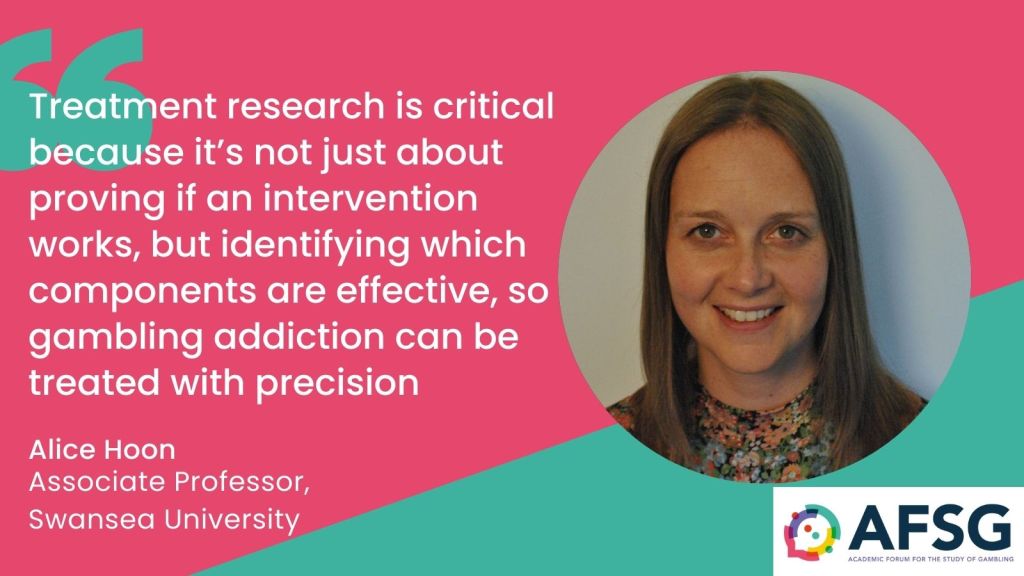
This month, we spoke to Alice Hoon, Associate Professor at Swansea University Medical School, to talk about issues in gambling addiction treatment, medical education and training, and the difficulties of recruiting study participants in this field. Alice’s position at the University’s Medical School and, therefore, role in medical education, gives her a particular insight into how gambling addiction is taught and treated and why more needs to be done to make students and healthcare practitioners aware of the topic.
When discussing the landscape of gambling addiction services across the UK, Alice highlights variability of provision as a key concern. England, for instance, has a network of NHS-funded gambling clinics, and Scotland is developing plans for its own clinic. In Wales, however, the absence of NHS-funded clinics leaves GPs and primary care practitioners without robust referral pathways, creating a patchwork of support options that often require patients to seek treatment far from home. Indeed, Alice has heard directly from GPs in Wales who – for lack of an accessible specialist service – have sometimes been compelled to refer their patients with gambling issues to general drug and alcohol services. This unequal access to services, which often hits those in rural communities especially hard, can translate into limited and fragmented support for individuals with gambling addiction, with clear implications for accessibility and continuity of care. Despite these challenges, Alice is quick to acknowledge the commendable work of several organisations in Wales that provide high-quality care for individuals struggling with gambling addiction.
Alice also raises critical points about how, or if, gambling addiction is introduced within medical education. While acknowledging the immense breadth of material medical students must master, she contends that gambling addiction’s prevalence and hidden nature necessitate greater curricular emphasis. Unlike other addictions, gambling addiction is typically free of overt physical symptoms, making it more challenging to identify in primary care settings. This underlines the importance of training future practitioners to recognise and address this condition effectively.
Another significant concern for Alice is the limited body of gambling addiction research conducted specifically within UK settings. She notes that a lack of collaboration historically between academic researchers and treatment providers has hampered research progress, admitting that academics need to improve in this respect. Treatment clinics often conduct their own evaluations, which are not published in peer-reviewed journals, resulting in a reliance on ‘grey literature’ rather than widely accessible evidence. ‘Treatment research is critical because it is not just about understanding whether an intervention works, but which components of the intervention work, so that gambling addiction can be treated with precision’, says Alice. Consequently, the field frequently depends on findings from international studies or on research centred on other addictions, which may not accurately reflect the needs of UK populations affected by gambling addiction.
The necessity for UK-specific research is critical, Alice argues, as treatment efficacy can vary by cultural and demographic factors, including gender and ethnicity. Treatment approaches informed by evidence from abroad or from populations with different experiences may lack relevance to diverse UK audiences. In particular, Alice highlights the underrepresentation of women in UK gambling research. Physiological and psychological differences between men and women can impact both the experience of addiction and treatment responsiveness, making it essential to consider these distinctions in developing effective interventions. Addressing this gap will require research that not only reflects the UK’s specific cultural context but also incorporates diverse patient perspectives to ensure inclusivity and efficacy.
There are several reasons for the lack of UK-specific evidence, but part of the problem could be the UK’s funding model for gambling research. Concerns about real or perceived conflicts of interest deter some researchers and providers from engaging with industry-sponsored funding, and the impact of these concerns is evident. It is for just these reasons that AFSG and Greo are developing the world’s first instrument to assess funding-related bias in gambling research. Independent, transparent funding mechanisms are essential to uphold academic integrity and public trust in research findings.
Nevertheless, even with sufficient funding, recruiting participants for gambling research remains an enduring challenge. Alice acknowledges the difficulty of balancing participant recruitment with ethical considerations around participant vulnerability. As she explains, individuals actively struggling with addiction may be among the most valuable participants yet there may be ethical issues regarding recruiting them safely. Researchers must navigate a delicate balance between safeguarding participants’ wellbeing and gathering meaningful data to advance treatment approaches.
As our conversation draws to a close, Alice reflects on the future of gambling addiction research with cautious optimism. Currently between projects, she expresses an interest in how treatment approaches, such as third wave therapies and contingency management, might be evaluated in a UK gambling addiction context. Additionally, she finds the work of those like Philip Newall and others on slowing down gambling and making it safer particularly interesting. “Gambling will always be part of society, but that doesn’t mean we can’t make it safer,” Alice asserts, emphasising the potential of research not only to treat gambling addiction but to make gambling environments themselves less harmful.

 Academic Forum for the Study of Gambling