Categories
Uncategorized

The Future of Regulatory Settlements

The following is a copy of our response to the Gambling Commission’s consultation on the future of regulatory settlement payments. We believe that regulatory settlements should, for the time being at least, remain ringfenced for work that specifically addresses gambling-related harms. This submission reflects the views of the AFSG’s Executive Committee alone.

We disagree with the Commission’s proposal that regulatory settlement funds should be added to the Consolidated Fund (CF) for the following reasons. Firstly, regulatory settlement funds arise from specific breaches by identifiable operators, often linked to demonstrable consumer harm. Applying these funds to gambling harm mitigation reflects the polluter pays principle, ensuring that harm resulting from regulatory failures is directly addressed. Regulatory settlements serve a dual deterrent purpose: first, as a financial penalty to reinforce compliance, and second, as a means to fund work and organisations that actively counter harmful industry practices. Operators understand that a regulatory settlement does not just result in a financial loss, but also carries with it a requirement to visibly contribute to addressing the harms that their breaches have caused. Redirecting settlements to the Consolidated Fund, by contrast, treats enforcement as a general revenue-raising exercise, undermining both the ethical rationale and the regulatory logic of the settlements. 

Secondly, the statutory levy and regulatory settlements serve different purposes regarding gambling harms mitigation. The statutory levy is designed to provide predictable, consistent funding, whereas regulatory settlements are episodic, harm-linked, and corrective. As a point of principle, it seems unfair that operators that abide by the terms of their licences should be expected to contribute the same proportion of their gross gambling yield to gambling harms mitigation work as operators which breach the terms of their licences. This would be the effect of transferring regulatory settlements to the CF. Such an arrangement is neither fair to responsible operators, nor does it provide any form of redress to those harmed by irresponsible operators. The existence of a levy does not remove the need for remediation where regulatory failures have occurred. Where direct remediation to specific, named customers is not possible, it is both more just and preferable that regulatory settlement payments be directed to gambling harms mitigation work.

Thirdly, once funds enter the CF, there is no guarantee – legal, procedural, or political – that they will be spent on gambling-related harm. While the Government may allocate funds from the CF back to gambling harms mitigation work, this is not a given. Indeed, a changed policy environment could see future tax cuts to the gambling industry funded – at least indirectly – via the CF. This risks creating a credibility gap with affected communities, treatment providers, and people with lived experience, who reasonably expect harm-related funds to address harm. Such a possibility is especially offensive to those who have been significantly harmed as a result of their own or someone else’s gambling.  

It should be noted that several other regulators already have similar arrangements in place that are based on polluter pays principles. Ofgem’s Energy Industry Voluntary Redress Scheme, for instance, directs payments from energy companies that have breached Ofgem rules toward projects that support energy customers in vulnerable situations or towards just transition or clean energy projects. The Financial Conduct Authority (FCA) has likewise moved towards a regulatory regime that prioritises redress for affected customers over fines that go to the CF: ‘We will prioritise compensation to consumers over fines where that is the right thing to do’ (FCA, 2024). Given the readily acknowledged economic costs of gambling (estimated in 2022 at between £1.05 and £1.77 billion per year in England alone according to Government figures), disassociating regulatory settlement payments from gambling harms mitigation risks being seen as a regressive step. 

Finally, a particular strength of the current regulatory settlement landscape has been the ability to fund genuinely innovative work. The creation of our own organisation, the Academic Forum for the Study of Gambling (AFSG), for instance, would likely not have been possible without the flexibility of regulatory settlement funding. The establishment of a group such as ours would likely not be possible under the levy structure either as we are neither a higher education institution nor a traditional prevention or treatment charity. Regulatory settlement funding, however, is ideally placed to support innovative approaches to gambling harms mitigation or work which is at risk of slipping through the gaps in a more tightly controlled and regulated levy framework. 

Once regulatory settlement funds enter the Consolidated Fund, their use is no longer hypothecated and becomes entirely decoupled from gambling harm mitigation. In a different or future policy environment, this creates a risk that such funds could support policy choices that are neutral or even counter-productive to harm reduction, including measures that benefit the gambling industry. 

The current consultation itself notes that “the Government can direct funds from the Consolidated Fund for any purpose they wish, and this could include those connected with gambling”. On that basis, it must also be acknowledged that a current or future Government could direct funds towards purposes that support the gambling industry and may exacerbate gambling-related harm. If such foreseeable scenarios are not considered, the proposal risks being insufficiently prudent and lacks robustness across different policy environments. 

The current proposal for regulatory settlements, moreover, assumes that the statutory levy will remain in its current form for the foreseeable future, even though it has not yet been in operation for 12 months. Indeed, the Explanatory Memorandum to the Gambling Levy Regulations 2025 states that a final evaluation report of the levy is not to be expected until autumn 2027. As such, the decision to add regulatory settlements to the CF at such an early stage of the levy’s life – and without any robust evidence as to the operation and impact of the levy – would seem to be premature.

We believe that there is a viable alternative to the current proposal. A core part of the current proposal is that it is necessary to align regulatory settlements with the statutory levy to avoid a duplication of effort and an uncoordinated approach. The Gambling Levy Programme Board (GLPB) and Gambling Levy Delivery Group (GLDG) are well placed to oversee the administration of regulatory settlement funds. 

The GLPB and GLDG could be tasked with overseeing a coordinated and strategic approach to the administration and application of regulatory settlement funds. To support effective administration and mitigate the challenges associated with the unplanned nature of such funding, regulatory settlement monies could be accumulated until a pre-defined threshold is reached (for example, £5 million). 

Once this threshold is met, the GLPB and GLDG could jointly agree an approach to the deployment of the funds. This could include, for example, the establishment of an innovation fund accessible to organisations working across research, prevention and treatment; allocation of funds in line with the existing 50-30-20 levy split; a targeted call for proposals addressing an identified gap, emerging risk or area of immediate concern; or other approaches consistent with the strategic priorities of the levy system. The Gambling Commission would not be eligible to receive funding under this arrangement, thereby effectively handling the concern that the Gambling Commission could be seen to have a vested interest in the collection of greater regulatory settlements.  

This model would address concerns about uneven or ad hoc funding, ensure regulatory settlement funds are fully integrated within the existing levy governance and commissioning framework, and support coordinated decision-making, effective evaluation and strategic alignment.  

An additional point for the Gambling Commission to consider is the destination of any regulatory settlements already collected but not yet allocated or which are collected before any changes are made to the current system. Until such a time as a new system is implemented, the Commission must consider how existing regulatory settlement funds are to be distributed. Such funds should be distributed in accordance with the version of 2.39 of the Statement of principles for determining financial penalties that was in force at the time the financial penalties were set. 

As for the timeline for any changes to the current system, a decision to decouple regulatory settlements from the purposes of gambling harms mitigation work is premature at this point in time. The levy is new and it has not yet been subject to any independent evaluation. It is, therefore, too early to make an informed decision on the future administration and application of regulatory settlements.  

Regulatory settlement funds should continue to be applied to gambling harm mitigation at least until the final evaluation report on the statutory levy is published in autumn 2027. Subject to the findings of that evaluation, the Gambling Commission could then appropriately revisit the question of the destination of regulatory settlements in late 2027 or 2028. 

This approach would also allow sufficient time for the Gambling Levy Programme Board (GLPB) and Gambling Levy Delivery Group (GLDG) to assess the effectiveness and impact of the proposed process under which they would be responsible for the coordinated distribution of regulatory settlement funding. If this arrangement is found to be effective, proportionate and well aligned with levy objectives, it should be retained on a longer-term basis, reflecting the fundamental principle that regulatory settlement funds should be used to address gambling-related harms. 

Finally, with regard to section 149 of the Equality Act 2010, it should be noted that gambling-related harm is not evenly distributed across the population. A substantial body of evidence demonstrates that certain groups, including individuals experiencing socio-economic deprivation, some minority ethnic communities, young men, and individuals with co-occurring mental health conditions, are disproportionately affected by gambling harm. There is also evidence that people experiencing disability, including mental health disability, may be at increased risk of experiencing gambling-related harm. 

Under section 149 of the Equality Act 2010, the Commission must have due regard to the need to eliminate discrimination, advance equality of opportunity, and foster good relations between persons who share a relevant protected characteristic and those who do not. In practical terms, advancing equality of opportunity includes removing or minimising disadvantages suffered by persons who share a protected characteristic and taking steps to meet their particular needs. 

The current regulatory settlement framework enables funds arising from operator misconduct to be directed towards targeted harm mitigation activity, including initiatives designed to reach disproportionately affected communities. Removing the hypothecation of such funds may reduce the Commission’s ability, indirectly but materially, to ensure that resources generated from regulatory breaches are used to address the needs of those most adversely impacted. 

In particular, the episodic and flexible nature of regulatory settlement funding has supported innovative or targeted work that may not fall neatly within mainstream commissioning structures. If such funding is absorbed into the Consolidated Fund and loses its sector-specific link, there is a risk that resources may become less responsive to the particular needs of protected groups who experience gambling harm at higher rates or with greater severity. 

While the proposal does not directly discriminate against any protected group, its indirect impact on the allocation and targeting of harm mitigation resources should be carefully assessed. A full equality impact assessment should consider whether removing the direct link between enforcement-derived funds and harm mitigation could reduce the capacity to advance equality of opportunity for those groups disproportionately affected by gambling harm.
Categories
Uncategorized

Advertising, Football and the Problem of Self-Regulation

In this month’s Member Spotlight, we caught up with Ellen McGrane, Research Associate in Alcohol and Public Health in the Sheffield Addictions Research Group at the University of Sheffield. Although currently working on alcohol and public health, Ellen’s recent PhD examined television gambling advertising and live sports. When it came to choosing her PhD topic, she was keen to work on an area that had relevance to contemporary policy, while also applying methodological approaches of interest, such as natural experiments, which remain underutilised in gambling research. Gambling advertising and harms stood out as an area of emerging public health interest that was less well understood or researched compared to alcohol and tobacco. In this month’s interview, we discuss the whistle-to-whistle ban, self-regulation in gambling advertising and the challenges of data collection and natural experiments in gambling research. 

Television gambling advertising in the UK is mostly self-regulated. It is not permitted between 5:30 am and 9:00 pm, unless for lottery or bingo products. Live sports broadcasts, however, are exempt from these regulations and are instead subject to a whistle-to-whistle ban that prevents gambling advertisements being shown from five minutes before kick-off until five minutes after the match ends. Gambling advertisements can, however, be shown outside this limited window and the ban does not apply to all live sports broadcasts – horseracing, for instance, is out of scope. While the whistle-to-whistle ban, therefore, reduces exposure to gambling advertising during a live sports event, this may be offset by increased advertising for other sports, greater non-television marketing or advertising outside the time period covered by the ban.  

What’s more, television advertising is only one kind of advertisement among many. What about embedded advertising on hoardings or shirts, social media and digital ads and direct marketing? These are not covered by the same regulations as TV advertising, resulting in a patchwork quilt of partial regulations, conditional bans and differing levels of enforcement. While it is difficult to compare across jurisdictions, evidence from alcohol and tobacco indicates that partial restrictions tend to be less successful than a coordinated approach. As with much else in this area, however, the research and data needed to be able to draw firm conclusions is lacking.    

One of the most significant barriers Ellen faced during her PhD was the difficulty of obtaining reliable consumer gambling data. In the UK, much gambling data is held privately by operators and is not readily available to researchers. Unlike alcohol and tobacco research, where sales data and long-running surveys are widely available, gambling research has historically lacked accessible and comprehensive datasets. While the situation is changing thanks to initiatives like the Gambling Survey for Great Britian, constraints on access to suitable data shaped the direction of Ellen’s research. 

In the absence of suitable existing datasets or major policy changes to evaluate, Ellen collected original survey data and supplemented it with scraped data where possible. While time-consuming and technically demanding, this approach made it possible to investigate questions that would otherwise have been difficult to answer. 

Designing and conducting a study from start to finish — from research design through to data collection and analysis — was ultimately one of the most rewarding aspects of the project. It also highlighted the practical challenges that continue to shape gambling research in the UK. 

Primary data collection allowed Ellen to study real-world gambling behaviour during the 2022 FIFA World Cup. In the UK, the rights to show World Cup matches are divided between the BBC (i.e. no advertising) and ITV, a commercial broadcaster which includes advertising breaks during which gambling adverts may be shown. 

Through self-reported data, Ellen was able to study the behaviour of men who gamble during live broadcasts of different matches on ITV and the BBC. The findings suggested that both the likelihood of betting and the number of bets placed were higher for matches shown on ITV than for those shown on the BBC. The study was designed so that games across broadcasters were highly comparable, ensuring that factors such as the match itself – for example an England game – did not influence betting, and the only differences were due to the advertising itself. 

These findings suggest that advertising may play a role in increasing overall betting activity, although larger studies are needed to confirm this relationship and to examine whether the relationship holds for other groups, including women. While men – and particularly young men – are an important target group from a public health perspective, further study is needed to understand how other demographics are affected by gambling advertising. This is particularly important as gambling advertising becomes more sophisticated and operators target their marketing to certain groups or demographics. 

What is clear is that gambling advertising and its relationship to gambling behaviours and harms is an emerging area which requires further research, particularly regarding newer and emerging forms of digital advertising. Questions of how and whom is most affected, the impact of different kinds of advertising, the effectiveness of self-regulation and the economic and social costs of gambling advertising all require further study. As gambling companies continue to pump millions into advertising their products and platforms, there is a need for researchers and public health authorities to invest in understanding the real-world implications of gambling advertising.

Categories
Uncategorized

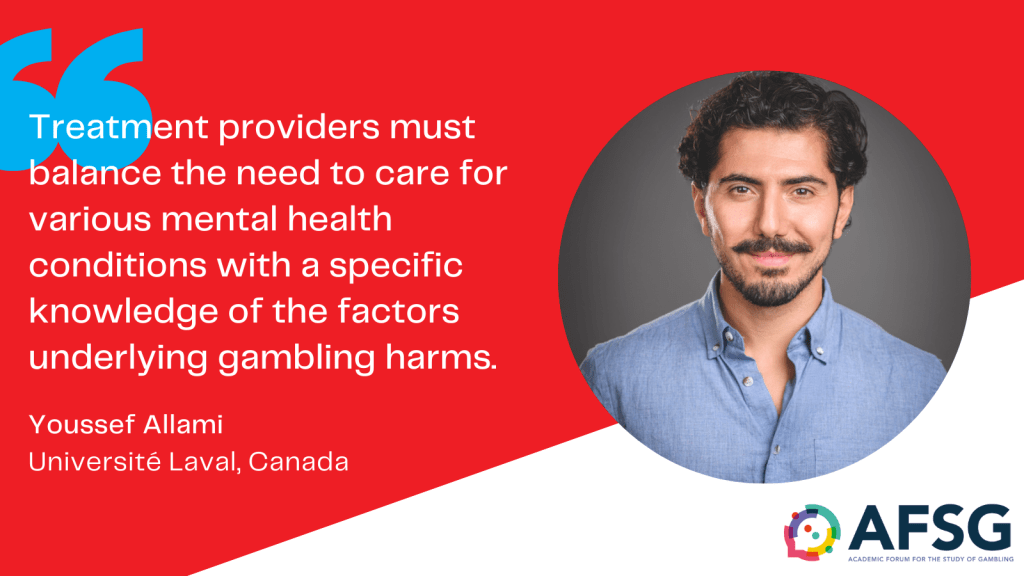
Harms, Treatment & Canada: Youssef Allami in Conversation

Youssef Allami is Assistant Professor in the School of Psychology at Université Laval in Quebec, Canada. In this month’s Member Spotlight interview he discusses his career in gambling studies, the regulation of gambling in Canada, treatment seeking and the importance of understanding the broader context of mental health and addiction when looking at gambling harms and problem gambling.  

Like many of the people interviewed for the AFSG Member Spotlight, Youssef did not start out determined to pursue a career in gambling studies. His main intention was to become a clinical psychologist, and it was only when his supervisor revealed he was beginning a research project on gambling that Youssef decided to switch from the Psy.D. programme with its focus on clinical practice to a PhD which combined clinical practice with an expanded programme of research. After completing his residency at Montreal’s largest publicly funded addiction and rehabilitation centre, Youssef spent five years working there as a clinician and doing some part-time research work. He subsequently went on to a postdoctoral position at the Alberta Gambling Research Institute (AGRI) before joining Université Laval. 

As a clinical psychologist and researcher, one of Youssef’s interests is how gambling harms are measured and understood. Harms can be felt across many domains, including financial, emotional/psychological and relationships among others. People who experience harm from their gambling may experience that harm across several domains or in just one or two of them. Some people, he says, will suffer harm because of their gambling but will not necessarily meet the criteria for a formal psychiatric diagnosis of gambling disorder. Youssef thinks this distinction between gambling harms and gambling disorder is poorly understood among researchers, policymakers and others. He argues that by disregarding gambling harms and instead focusing solely on formally diagnosed cases of gambling disorder, some politicians and the gambling industry have been able to downplay the negative impacts of gambling in Canada. 

In some ways, the Canadian context and approach to regulation have aided this process. While gambling was legalised by the federal government, the right to manage and regulate it is devolved to the individual provinces. Most provinces manage gambling through state-owned monopolies, but some, such as Ontario, have opened up to private operators. This has led to a situation in which neighbouring provinces may adopt very different regulatory approaches, but given pervasive marketing and the accessibility of online gambling it is increasingly difficult for provincial governments to fully regulate gambling marketing and participation in their own provinces. The move to welcome private operators by some provinces, meanwhile, has opened the doors for industry lobbyists to talk up the economic benefits of gambling, while downplaying the socio-economic harms. Youssef and other researchers in Canada have argued for a pan-Canadian approach to issues such as marketing, but as a small community of academics with limited resources they haven’t been able to score many successes in this regard.  

To better understand the Canadian context, Youssef is currently working on a project that examines how gambling has evolved in recent years across the Canadian provinces and how it may develop in the future, particularly in relation to differing provincial regulatory frameworks. Some of these findings could, perhaps, inform a future pan-Canadian strategy.  

As well as these larger trends and patterns, however, Youssef is very much interested in individual experiences of gambling, gambling harm and treatment seeking behaviours. In his recent research, he has examined treatment seeking behaviours among Canadians experiencing gambling harms. That research shows an average time lag of four years between people first becoming aware of their problem gambling and subsequently seeking treatment for it. He and his research team asked participants what first made them realise they had a problem and what then led them to seeking treatment. In both cases, financial problems emerged as the primary reason. According to Youssef, the reason for the four-year lag between problem awareness and treatment seeking may be explained by the fact that individuals often try to recoup their losses before seeking assistance. 

Another aspect of treatment that Youssef researches is addiction substitution and co-morbid conditions. His research suggests that in some cases, people who are actively trying to reduce their gambling may substitute another addictive substance or behaviour in its place, such as alcohol or drugs. People with co-morbid mental health conditions may be most likely to follow this pathway and it may be this group that requires the most attention from a clinical perspective. 

Indeed, according to Youssef’s research, some people who had previously sought treatment for mental health conditions actually began experiencing gambling problems while they were undergoing treatment for their mental health condition(s). This highlights a challenge for treatment providers who must balance the need to provide a wide package of care for various mental health conditions with a specific knowledge of the factors underlying gambling harms and gambling disorder. This combination of the general and the specific can be hard to achieve, although Youssef points to New Brunswick’s model which mixes general mental health and addiction services with regional gambling champions who have deeper experience of gambling than other mental health and addiction professionals. 

As both a researcher and clinical psychologist, Youssef’s work extends beyond gambling into substance use disorders and mental health. Given the relationships between gambling harms, substance use and mental health, he believes it’s important for researchers to have a broad understanding of the wider issues that can impact people who suffer harm from their gambling. This, he argues, is important as it allows researchers to spot commonalities as well as differences across addictions and compulsive behaviours.  

As our conversation comes to an end, I ask Youssef what he, his colleagues and students are currently working on. While he is working on a project to better understand attachment styles and addictive behaviours, he’s keen to highlight a couple of projects his students are leading. The first is examining how newly arrived immigrants may be at greater risk of gambling harms while simultaneously being less likely to seek help, and a second is looking at how women who have experienced addiction are treated by the judicial system. Taken together, these projects highlight an interest in and awareness of the fact that behind the statistics on gambling are real people who experience and try to deal with harms in myriad ways , and that society also has a role to play in reducing the harms experienced by individuals facing addiction-related problems.   

Categories
Uncategorized

CAGR 2026: Call for Abstracts and LMIC Bursary Launch

On 28 and 29 May 2026, the Current Advances in Gambling Research (CAGR) conference will take place in the beautiful Finnish capital, Helsinki. This week, the conference organising committee opened the call for abstracts and the low- and middle-income country (LMIC) bursary.

The conference focuses on sharing new and emerging research in the field of gambling studies. This year, we’re particularly keen to see submissions focusing on sociology of gambling, real-world impact, and control & governance.

Accepted contributions will be presented as oral presentations (15 minutes) or posters. For both types, abstracts should be 250 words max. We also invite proposals for pre-conference workshops, to be held on 27 May.

We encourage submissions from early career researchers, professionals from the third sector, regulators, individuals with lived experience, and researchers from the Global South.

The deadline for abstract submissions is January 15, 2026. Authors will be notified of acceptance decisions by 20 February 2026. Registration will open in February. And don’t forget, AFSG members enjoy a significantly reduced ticket price!

In addition, the LMIC bursary returns for 2026. Researchers who would like to present at the conference and who work or study at an LMIC university may be eligible to apply. Successful applicants will be awarded funding to cover the costs of travel to and from the conference, plus accommodation and visa costs. Conference fees will also be waived. The deadline to apply for the LMIC bursary is 31 December 2025.

Categories
Uncategorized

AFSG Response to APPG Gambling Reform Call for Evidence

Over the summer, the All Party Parliamentary Group for Gambling Reform issued a call for evidence to support their upcoming inquiry on the future of gambling regulation in the UK. The inquiry is wide ranging and will examine multiple aspects of regulation, including legislation, advertising and marketing, the statutory levy and new and emerging kinds of gambling. The AFSG Executive Committee issued the following response to the inquiry. This response reflects the views of the Executive Committee alone and is not intended to speak on behalf of AFSG members.

The Academic Forum for the Study of Gambling (AFSG) was established in 2021 to foster independent, high quality academic evidence on gambling related subjects. We have several hundred members and, to date, have supported nineteen academic research projects, and four international conferences, using ring-fenced regulatory settlement monies.

Scope of this submission

We address two APPG priority areas where the AFSG has directly supported evidence development:

  • Gambling advertising, sponsorship and marketing; and
  • Optimal strategies for the long-term success of the statutory levy in supporting research (with links to treatment and prevention).

1) Gambling advertising, sponsorship and marketing

AFSG conferences in 2023, 2024 and 2025 each included dedicated sessions on this theme with at least five presentations per event.1

Rather than detail the myriad issues surrounding advertising, sponsorship and marketing, we would like to draw the APPG’s attention to the AFSG-funded studies that speak directly to current concerns:

  • Direct communication within the social media marketing of gambling: A machine learning approach (completed 2023)
  • The development and evaluation of a brief intervention that incorporates gambling advertising scepticism and persuasion inoculation; a mixed-methods exploratory project (completed 2024)2
  • Compliance with Loot Box Advertising Rules in the UK and South Korea (completed 2025)3
  • Using the Meta Ad repository to empirically assess advertising of gambling and gambling-like mechanics in video games (due to report in late 2025)

Projects (3) and (4) also speak to another theme of interest to the APPG, namely, how to ensure the effective regulation of new and emerging forms of gambling (inc. crypto-gambling, social casinos). As well as the two listed projects, we have also supported research projects related to new and emerging forms of gambling, particularly those which coalesce around the interface of gaming and gambling.4

2) Optimal strategies for ensuring the long-term success of the Statutory Levy and the delivery of research, treatment and prevention work

AFSG’s remit focuses on research. Over recent years we have developed a robust commissioning model which has credibility across the academic research community for evaluating proposals and awarding funding. This model incorporates rigorous peer review, clear and detailed feedback to applicants, transparent decision-making and the publication of outcomes via our website.

With the introduction of the statutory levy, processes are being developed to award research funding via established national research councils. We welcome the shift away from industry influence towards recognised academic funding bodies. However, the extent of gambling-specific expertise in those councils is not yet clear, and the decision to assign a lead role to the Arts and Humanities Research Council (AHRC) would benefit from a clearer rationale. It is concerning that in a field as sensitive to issues of industry involvement, UKRI’s first funding opportunities should permit research relationships with the gambling industry. Such a position risks undermining the independence of the levy and replicating the disagreements and animosities prompted by the previous system of voluntary contributions. Many from the research world, including numerous AFSG members, have had to point out the many potential problems inherent in involving the gambling industry in gambling research. Deadlines for applying for funding from initial funding calls have already been postponed, in response to several criticisms of the process, and there is a lack of transparency over how the research priorities have been determined.

We highlight the AFSG’s model built on an international panel of experienced reviewers and rigorous, gambling-specific conflicts of interest screening protocols as evidence of a practical approach that nurtures and uses credible evidence on gambling issues free from industry influence. This model has supported annual research calls, and the award of several major and minor grants each year, together with postgraduate awards and conference travel grants. The model we have developed is especially good at providing relatively smaller-sized research grants (£25k-90k) and supporting early career researchers (ECRs) – an important area that has been somewhat neglected by the first phase of the levy system with its focus on multi-million-pound partnerships and research grants. The national research councils may be better placed to administer and monitor larger-sized grants, if they can recruit sufficiently suitable experienced peer reviewers, and their existing processes are geared towards this. This does, however, leave a gap which organisations like ours have been successfully fulfilling for some years, i.e. the provision of smaller grants for innovative research and less-established researchers who may not be eligible for larger UKRI awards.

Finally, we believe that the research portion of the levy should consider new mechanisms to promote the involvement of third sector organisations in research. Charities can and do play an important role as partners in academic research. Lived experience organisations and treatment providers, as well as support organisations like the AFSG, support, fund and co-design research projects. As such, we would propose the establishment of a ring-fenced fund to which charitable organisations can apply directly to support gambling harms research in a variety of ways.

Summary recommendations

  • Enforce a clear separation between academic research and gambling industry involvement.
  • Create a complementary funding route outside standard UKRI mechanisms to award smaller research grants and ECR-focused awards to ensure a healthy pipeline of gambling harms researchers in the future.
  • Establish a ring-fenced fund for third sector organisation participation to support the funding, co-development and support of academic research on gambling related harms.

Yours sincerely,

Prof Simon Dymond, Prof Elliot Ludvig, Prof Amanda Roberts, Dr Jim Rogers, Dr Stephen Sharman, Prof Richard Tunney (AFSG Executive Committee)

  1. See archived conference programmes here: https://cagrconference.org/previous-conferences-2/. ↩︎
  2. See https://onlinelibrary.wiley.com/doi/pdf/10.1111/add.16732 and https://academic.oup.com/jpubhealth/article/46/4/e654/7727368 for peer-reviewed research articles from this project. ↩︎
  3. See https://akjournals.com/view/journals/2006/14/2/article-p714.xml for this research paper. ↩︎
  4. Predatory monetisation?: the shift of digital game design into gamblification and its effects on players (completed 2023). ↩︎
Categories
Uncategorized

Celebrating Diversity & Inclusion at CAGR 2025

This year’s Current Advances in Gambling Research conference (CAGR) was a truly international affair with more than 80 speakers representing research from over a dozen countries. From Malawi to the Netherlands and Australia to Finland, CAGR 2025 highlighted the variety and wealth of research being conducted to prevent, reduce and address gambling-related harms. At the same time, the conference offered diverse disciplinary perspectives and provided everyone – from PhD students to well-established professors and experts by experience – an opportunity to present their research findings to their peers.

University Cloisters: Venue for CAGR’s evening drinks reception.

It would be impossible (and unfair) to summarise the entire conference in just a few hundred words. Instead, let’s focus on just a few key themes and issues that arose from the dozens of talks and presentations given over both days. From the first plenary session, it was clear that concern about the harms caused by gambling is almost universal. The Global Gambling Perspectives panel gave an insight into just some of the issues – from concerns around adolescent gambling in Georgia (Guga Besilia) to the marketing tactics of gambling companies in Malawi (Junious Mabo Sichali). Clearly, not all countries are equally represented when it comes to the body of academic research on gambling harms. To hear a range of perspectives from around the world, therefore, in the first plenary session of the conference gave an insight into what could be expected from the rest of the event. Interspersed throughout the conference were talks and presentations from around the world – New Zealand, South Africa, Spain, and Nigeria to name but a few. While some of the challenges faced by countries may be unique, many of the issues raised were of cross-country or even global concern.

As well as geographical diversity, the conference also provided a diversity of disciplinary approaches. Gambling studies sits at an intersection of disciplines from psychology and economics to public health and criminology. Hearing how gambling harms are approached through different academic disciplines was eye-opening – from Michele Stacey’s study of gambling treatment diversion courts in the US (criminal justice and criminology) to Francisco Nobre’s work on the relationship between the proximity of gambling shops and gambling harms (economics). In many ways, while CAGR is a gambling studies conference it is also by its very nature a series of conferences celebrating the array of disciplines that make up gambling studies.

Duke of Wellington with traffic cone: A Glasgow icon.

A third theme that was evident throughout the conference was the inclusion of people at different stages of their careers. This was as true of academic researchers as it was of experts by experience and affected others. It was refreshing to see panels where established professors would present their research findings alongside those of PhD students and early career researchers. It was equally inspiring to hear from affected others presenting for the first time, as well as experts by experience with many years’ experience working and collaborating on research projects.

More than anything, it is the people who attend, present, network and run CAGR that make it what it is. It is designed by and for people who are interested in and care about gambling research. Attendee feedback is hugely important in refining and improving the conference for the following year. Attendees should have received a link to the feedback form and we’d be grateful to everyone who can spend a few minutes to complete it.

Finally, the work and dedication of the organising committee of CAGR 2025 needs to be acknowledged. Organising and running a great conference that reflects the diversity and interdisciplinary nature of the gambling research field is a huge undertaking that is months in the planning. The organisers are not professional event planners, but rather academics, ECRs and experts by experience who spend months planning, emailing, updating, chasing and organising so that CAGR can continue to offer an independent and equitable platform to present the latest findings from the field of gambling studies.

And in case you missed it, CAGR 2026 will be taking place in the fabulous city of Helsinki. We’ll be sharing more details in the months to come, so keep an eye on your inboxes.

Categories
Uncategorized

Valuing Lived Experience in Gambling Research: Steve Sharman in Conversation

Steve Sharman is a Senior Research Fellow at King’s College London with interests in gambling, behavioural addictions and decision making. He is also a member of the Executive Committee of the AFSG and co-organises the Current Advances in Gambling Research (CAGR) conference each year. In this month’s conversation, Steve talks about the importance of lived experience, the need for an independent and inclusive conference for researchers to share their work, the use of virtual reality in gambling research, and much more. 

A few weeks ago, Steve and his team launched the Lived Experience Research Hub (LERH), a new website designed to improve collaboration between academics and people with lived experience of gambling harms. ‘Often, researchers would have what they thought was a great idea for a piece of work and would then try to bring in people with lived experience once the project had already started,’ says Steve. The problem with this approach is that the inclusion of lived experience comes too late. ‘We advocate for lived experience to be incorporated into the research process from the very start, so we need to provide an avenue for academics and people with lived experience to find one another,’ says Steve. The LERH’s matching service does this by allowing academics to post details of jobs for which they are looking for people with lived experience. The idea, explains Steve, is to promote deeper and more impactful ways of incorporating lived experience into every stage of the research process. 

Reflecting on his own work, Steve admits that incorporating lived experience into the research process isn’t without its challenges. ‘Sometimes people with lived experience will ask me why I’m approaching a particular issue in a given way,’ he says. ‘Responding with “because that’s the way we do things in academia” just doesn’t cut it,’ he concedes. ‘Collaborating with people who have lived experience of gambling harms helps you incorporate different ways of thinking into your work — and it can be incredibly rewarding.’ 

Another element of the LERH is the Minimum Standards Framework (MSF). Steve and many of his colleagues have witnessed examples of lived experience involvement that don’t go to plan. Developed in collaboration with individuals with lived experience of gambling harm, the MSF is intended to address some of the more common issues identified both by academics and people with lived experience when it comes to establishing productive collaborative working relationships. ‘The MSF is not designed to be a set of instructions, more a set of guidelines to provide academics with a framework of how best to work with people with lived experience,’ says Steve. It provides practical advice on issues like the provision of support and care, fair remuneration, and safeguarding. 

The inclusion of lived experience in the research process extends to the annual Current Advances in Gambling Research (CAGR) conference, which Steve and fellow academics Amanda Roberts and Simon Dymond established a few years ago. CAGR was founded to provide gambling studies academics with a way to present their work to one another to gain critical, but friendly feedback from colleagues. As part of this, the conference has tried hard in recent years to incorporate lived experience, including by prioritising speakers whose work includes a strong element of lived experience. ‘From the outset, we wanted the conference to provide an independent and inclusive environment in which gambling studies research could be presented,’ says Steve. As part of this commitment, Steve and colleagues have sought to foster the equal involvement of early career researchers alongside more established academics, as well as committing to eliminating all-male panels and providing bursaries for participants from the Global South. ‘We also offer heavily discounted tickets for students, people with lived experience and the unwaged,’ says Steve. According to Steve, the preliminary programme for CAGR 2025 (which takes place in Glasgow in June and has a few tickets remaining) showcases this commitment to inclusivity, with a strong focus this year on global perspectives and the inclusion of lived experience. ‘There’s still more to be done,’ he says, but he hopes that through commitments like these CAGR can be a forum for more equitable and accessible gambling studies research.  

Beyond running a website, organising a conference, acting as a trustee for the Society for the Study of Addiction (SSA) and sitting on the Advisory Board for Safer Gambling (ABSG) and the AFSG’s Executive Committee, however, Steve’s primary role remains gambling research. At present, he’s working on a UKRI-funded piece of research that uses virtual reality (VR) to better understand the psychological underpinnings of gambling behaviour. The use of VR arose from criticism of more traditional studies of gambling behaviour where participants, for example, would be asked to hit the spacebar or click a mouse on a very crude gambling game on a PC. While offering a high degree of experimental control, the trade-off with such methodologies is that they are not always reflective of real-world gambling conditions or environments, meaning research findings are necessarily constrained. By using VR, Steve hopes to improve the ecological validity of such studies by immersing participants in a much more realistic environment in which multiple variables can be controlled.     

The use of VR and the creation of a much more immersive environment, however, aren’t without their challenges. Electronic gaming machines incorporate several mechanisms aimed at encouraging players to spend more time and money on them. Replicating these conditions too closely or not ensuring sufficient safety mechanisms could expose study participants to unacceptable levels of potential harms. For these reasons, Steve’s work with VR incorporates several safety mechanisms, such as removing potential participants with Problem Gambling Severity Index (PGSI) scores above a certain level, keeping VR sessions relatively short, and debriefing all participants at the end of their session. 

Another area of research for Steve in recent years has been football and its relationship with gambling. As well as being a research interest of his, however, football is also a personal interest. One question that arises is whether gambling as a research topic has affected his enjoyment of football as a passion. ‘I wouldn’t say it’s affected my enjoyment of the game, but it has 100% affected how I view the game,’ admits Steve. ‘It’s impossible to watch a Premier League football match, or my team, Derby County, now without thinking about work,’ he says. It does, perhaps, go some way to explaining why Steve prefers to follow non-league football. ‘Non-league football is much more community focussed, and isn’t saturated with gambling ads and companies,’ says Steve. Shirt sponsors are more likely to be local companies than big betting firms and there’s very little gambling content on the clubs’ social media feeds. ‘I still enjoy the sport,’ says Steve, ‘but maybe my work has influenced the type of football I follow’. 

Categories
Uncategorized

Exploratory Grant Award Winners 2025

The Research Committee of the AFSG has recently confirmed the recipients for 2025’s major and minor exploratory grants. The funded projects will examine how to improve retention in NHS gambling services, the relationships between social identification with sports and gambling behaviours, and the use of natural language processing to understand how first-hand gambling experience relates to Problem Gambling Severity Index (PGSI) scores.

High dropout rates from addiction treatment services have been documented globally. There can be many drivers behind dropout, although current understanding of the precise reasons and predictors of dropout among people in the UK seeking help for problem gambling is relatively weak. Matt Field (University of Sheffield) will lead a major exploratory research project that looks at the factors underlying dropout, including among people who are referred (or self-refer) to a service but do not attend an initial appointment. Using data from the NHS Northern Gambling Service, Matt and his team will use machine learning methods to study predictors of treatment retention/dropout and to better understand why 40% of those referred to the service do not attend an initial appointment. Discussing the study and its potential impacts, Matt says:

“My colleagues and I are excited to begin this programme of work, which will use advanced statistical techniques that have been used in other areas of mental health and clinical psychology in recent years. We are delighted to partner with the NHS Northern Gambling Clinics, and our findings will shed light on the factors that determine dropout from treatment, in many cases even before the initial clinical assessment. Our approach has the potential to identify client characteristics and other contextual factors that can be the target of focussed interventions to improve engagement and retention in treatment, and thereby improve the outcomes of treatment”.

Meanwhile, the first of two minor exploratory awards has gone to Dr. Christopher Wilson (Teesside University) for a project exploring how social identification with sports groups predicts gambling behaviour. In addition, the research will examine the normalisation of gambling within certain sports groups and develop recommendations for stakeholders on their approaches to gambling harm reduction. Highlighting the links between sport and gambling in the UK, Christopher comments:

“The increasing prominence of gambling in professional sports broadcasting and sponsorship creates an association between them, to the extent that gambling is starting to become a normalised part of socialising around some sports. It’s important that we understand which features of gambling behaviour are predicted by this relationship, and how sports groups experience the exposure to gambling, so we can provide evidence to support targeted harm-reduction approaches.”

The second minor exploratory grant has been awarded to Simon T. van Baal (University of Leeds) for his research using natural language processing (NLP) to examine how narrative descriptions of gambling experiences correlate with PGSI scores. The PGSI questionnaire is one of the most commonly used tools to assess gambling harm, although it relies on people being able to accurately recall their activities and willing to admit when gambling has caused them harm. In addition, some yes/no questions do not allow for fuller explanations of those answers. This project will use natural language processing and artificial intelligence to analyse autobiographical descriptions of gambling behaviour and gambling harms. The research aims to use these technologies to identify how autobiographical accounts of gambling activity and gambling harms relate to PGSI scores and whether NLP models can be used as predictors of gambling harm. Talking about the use of NLP and artificial intelligence to identify gambling harms, Simon says:

My collaborators, Philip Newall and Lukasz Walasek, and I are excited to embark on this new project and thank the AFSG for their support. We believe accurately measuring gambling harm is part of the bedrock of gambling research, which is essential for developing and implementing evidence-based interventions. Understanding how the state-of-the-art measurement tools map onto real-life experiences will help us see the person behind the questionnaire score, possibly improving measurement and more tailored treatment options.

Work on all three research projects is expected to begin in mid-2025 and it is hoped that insights from each will help to improve the identification and treatment of gambling harms in the UK.

Categories
Uncategorized

Introducing the Lived Experience Research Hub

The inclusion of lived experience in gambling research is vital in ensuring more equitable, inclusive and effective outcomes, but finding the right partners with the right skills can be difficult and time consuming. The new Lived Experience Research Hub (LERH) is now live and brings together three services:

👉 Matching service: A new tool to help both researchers and lived experience experts find and connect with one another to collaborate on research projects
👉 Lived Experience Access Fund (LEAF): A funding programme that supports people with lived/living experience of gambling harm, enabling active participation in research, training, conference travel, and other related capacity-building opportunities
👉 Minimum Standards Framework (MSF): A set of guiding principles to which researchers should adhere to provide adequate care, support and opportunity to those with lived experience of gambling harm.

The service exists to support both researchers and those with lived/living experience of gambling harms to find, connect and collaborate with one another, while also providing funding to upskill those with lived/living experience to be part of research projects to better understand how to prevent, reduce and treat gambling harms.

Users can create an account now, post jobs, apply for LEAF funding and explore the opportunities on offer.

Categories
Uncategorized

Postgraduate Research Support Grants: Apply Now

Applications for our postgraduate research support grants are now open. Awards of up to £3,300 per person are available to PhD students and to those who hold postdoctoral positions to offset the costs of conducting research that directly or indirectly informs efforts to address gambling-related harm. Applicants must be registered as a PhD student or hold a postdoctoral research position with a UK university. Applicants must also be members of the AFSG.

Previous awardees of the postgraduate research support grants have used the funds to study issues such as loot boxes and microtransactions in games, the policy roles of women harmed by gambling, and the causal dynamics of behavioural dependence and gambling harms. Applications are welcomed from a wide range of disciplines and approaches.

Those wishing to submit an application must first complete an Expression of Interest by 11 April, with full applications due by 16 May. Only those who have first submitted an EOI will be eligible to submit a full application. Applicants must also complete a conflicts of interest form as part of their application.