
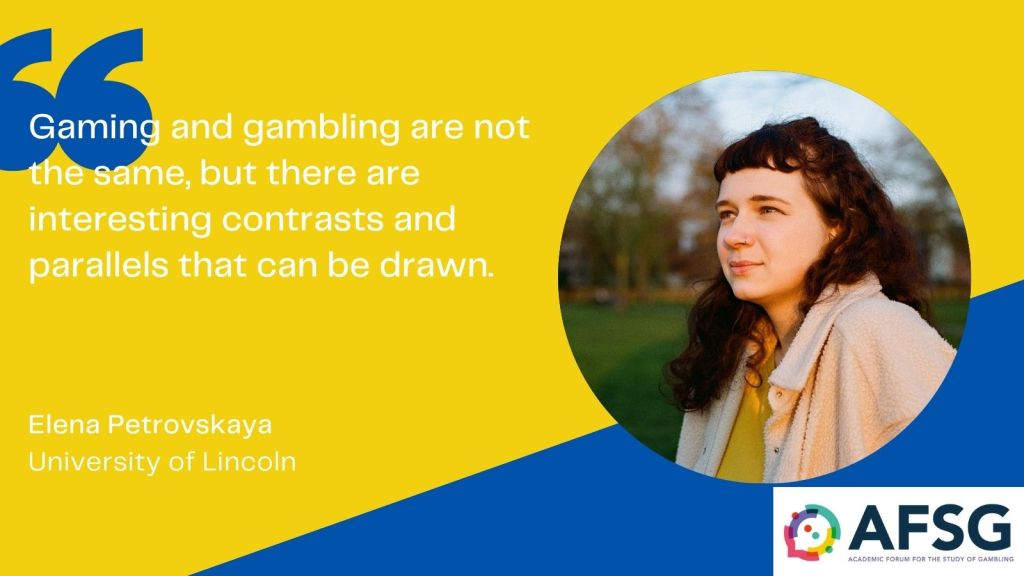
Elena Petrovskaya is a Postdoctoral Research Associate at the University of Lincoln with research interests in both gaming and gambling. In this month’s Member Spotlight, she discusses the ethics of microtransactions in games, the links between gaming and gambling and the difficulties of regulating vastly different types of games with a diverse approach to monetisation and microtransactions.
When she began studying games, Elena was initially more interested in design and the creative process behind games rather than the nexus between gaming and gambling. As she became more engaged in the topic of games, however Elena began to consider the real-world impact that games have, including the negatives of game play and how those effects could be mitigated. Personally, she had seen how friends’ behaviour toward game play changed when monetisation was introduced. It was at this point that the direction of her PhD changed to focus on monetisation and microtransactions, i.e. in-game purchases. She quickly realised that it would be impossible to study microtransactions in gaming without considering gambling. ‘There are lots of parallels between gaming and gambling – emotional response, the layout and design of games, advertising…’, says Elena.
Despite these parallels, Elena is keen to emphasise the differences between gaming and gambling too and says that microtransactions in games are not inherently problematic. According to Elena’s research, microtransactions can be ethical when people enjoy the game and wish to support it through spending on items or upgrades that enhance their enjoyment and game experience. Such spending is not inherently different to how others may spend on hobbies such as sports or crafting. ‘Microtransactions become problematic when they affect your ability to progress in a game’, says Elena. In such cases, players must pay to avoid having something taken away from them, rather than paying to add to their game experience.
There are still many questions to be answered, however, about how problematic microtransactions can be according to Elena. While there are players who can spend significant amounts on microtransactions in games, this isn’t necessarily evidence of harm or addiction. Big spenders may have larger incomes and could spend on games as a hobby. There are also important differences between types of players, different male and female perspectives and experiences of games and considerable variety between types of game that all need to be considered.
When it comes to regulation, therefore, striking a balance between these various factors is important. When I ask Elena about whether lessons can be learned from the regulation of gambling, she is keen to emphasise the differences between the two. ‘Gaming brings a lot of net positives’, according to Elena, meaning that the model of gambling regulation in the UK is not necessarily a suitable one for gaming. There are certainly areas of common concern, however, such as ensuring protection for under-18s and vulnerable people. In addition, more research is needed to understand when and how microtransactions can cause harm. Elena argues that ‘some form of regulation is needed’, but believes it could be quite different to gambling regulation. Experience from other countries, including Belgium, shows that the effective regulation of games requires considerable resources to ensure compliance with advertising regulations, protection of under-18s and games-specific expertise. It would also involve working with a not inconsiderable number of stakeholders – games designers and companies, tech platforms, players and others. The discussion of regulation and the Belgian experience relates to a piece of AFSG-funded research Elena is currently working on. Beyond gaming, Elena is working on a piece of research on gambling-related suicide in conjunction with colleagues at Lincoln. She says she is using the qualitative skills she developed in her PhD – such as building rapport and interview technique – on the difficult and sensitive topic of gambling-related suicide.
As for the future, Elena is keen to keep researching both gaming and gambling. She is particularly interested in the diverse perspectives of multiple stakeholders on both topics. Having developed her knowledge of gambling in recent months, she is better able to spot the similarities and differences between gaming and gambling. ‘Gaming and gambling are not the same, but there are interesting contrasts and parallels that can be drawn’, says Elena.






 Academic Forum for the Study of Gambling