
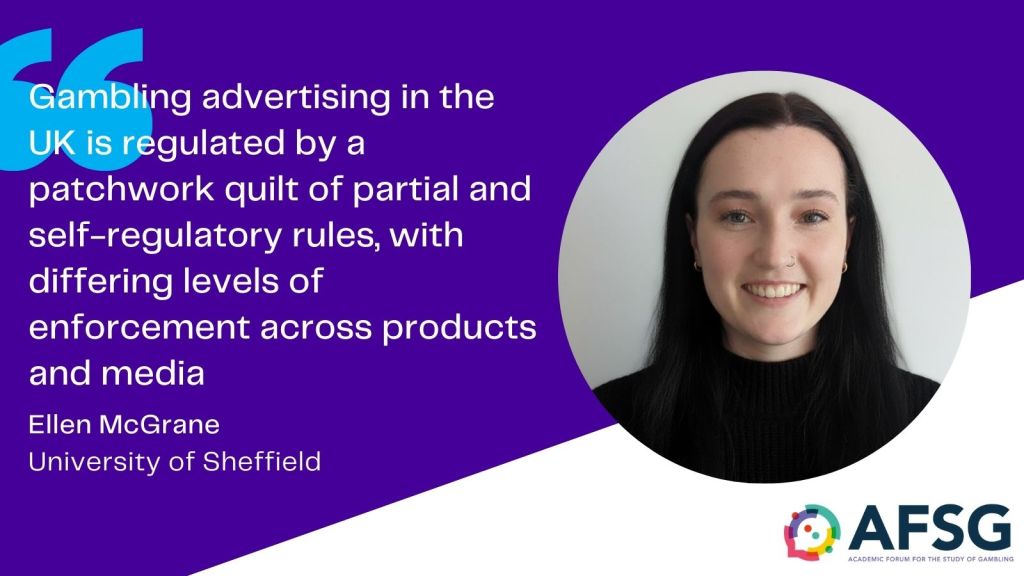
In this month’s Member Spotlight, we caught up with Ellen McGrane, Research Associate in Alcohol and Public Health in the Sheffield Addictions Research Group at the University of Sheffield. Although currently working on alcohol and public health, Ellen’s recent PhD examined television gambling advertising and live sports. When it came to choosing her PhD topic, she was keen to work on an area that had relevance to contemporary policy, while also applying methodological approaches of interest, such as natural experiments, which remain underutilised in gambling research. Gambling advertising and harms stood out as an area of emerging public health interest that was less well understood or researched compared to alcohol and tobacco. In this month’s interview, we discuss the whistle-to-whistle ban, self-regulation in gambling advertising and the challenges of data collection and natural experiments in gambling research.
Television gambling advertising in the UK is mostly self-regulated. It is not permitted between 5:30 am and 9:00 pm, unless for lottery or bingo products. Live sports broadcasts, however, are exempt from these regulations and are instead subject to a whistle-to-whistle ban that prevents gambling advertisements being shown from five minutes before kick-off until five minutes after the match ends. Gambling advertisements can, however, be shown outside this limited window and the ban does not apply to all live sports broadcasts – horseracing, for instance, is out of scope. While the whistle-to-whistle ban, therefore, reduces exposure to gambling advertising during a live sports event, this may be offset by increased advertising for other sports, greater non-television marketing or advertising outside the time period covered by the ban.
What’s more, television advertising is only one kind of advertisement among many. What about embedded advertising on hoardings or shirts, social media and digital ads and direct marketing? These are not covered by the same regulations as TV advertising, resulting in a patchwork quilt of partial regulations, conditional bans and differing levels of enforcement. While it is difficult to compare across jurisdictions, evidence from alcohol and tobacco indicates that partial restrictions tend to be less successful than a coordinated approach. As with much else in this area, however, the research and data needed to be able to draw firm conclusions is lacking.
One of the most significant barriers Ellen faced during her PhD was the difficulty of obtaining reliable consumer gambling data. In the UK, much gambling data is held privately by operators and is not readily available to researchers. Unlike alcohol and tobacco research, where sales data and long-running surveys are widely available, gambling research has historically lacked accessible and comprehensive datasets. While the situation is changing thanks to initiatives like the Gambling Survey for Great Britian, constraints on access to suitable data shaped the direction of Ellen’s research.
In the absence of suitable existing datasets or major policy changes to evaluate, Ellen collected original survey data and supplemented it with scraped data where possible. While time-consuming and technically demanding, this approach made it possible to investigate questions that would otherwise have been difficult to answer.
Designing and conducting a study from start to finish — from research design through to data collection and analysis — was ultimately one of the most rewarding aspects of the project. It also highlighted the practical challenges that continue to shape gambling research in the UK.
Primary data collection allowed Ellen to study real-world gambling behaviour during the 2022 FIFA World Cup. In the UK, the rights to show World Cup matches are divided between the BBC (i.e. no advertising) and ITV, a commercial broadcaster which includes advertising breaks during which gambling adverts may be shown.
Through self-reported data, Ellen was able to study the behaviour of men who gamble during live broadcasts of different matches on ITV and the BBC. The findings suggested that both the likelihood of betting and the number of bets placed were higher for matches shown on ITV than for those shown on the BBC. The study was designed so that games across broadcasters were highly comparable, ensuring that factors such as the match itself – for example an England game – did not influence betting, and the only differences were due to the advertising itself.
These findings suggest that advertising may play a role in increasing overall betting activity, although larger studies are needed to confirm this relationship and to examine whether the relationship holds for other groups, including women. While men – and particularly young men – are an important target group from a public health perspective, further study is needed to understand how other demographics are affected by gambling advertising. This is particularly important as gambling advertising becomes more sophisticated and operators target their marketing to certain groups or demographics.
What is clear is that gambling advertising and its relationship to gambling behaviours and harms is an emerging area which requires further research, particularly regarding newer and emerging forms of digital advertising. Questions of how and whom is most affected, the impact of different kinds of advertising, the effectiveness of self-regulation and the economic and social costs of gambling advertising all require further study. As gambling companies continue to pump millions into advertising their products and platforms, there is a need for researchers and public health authorities to invest in understanding the real-world implications of gambling advertising.
 Academic Forum for the Study of Gambling