
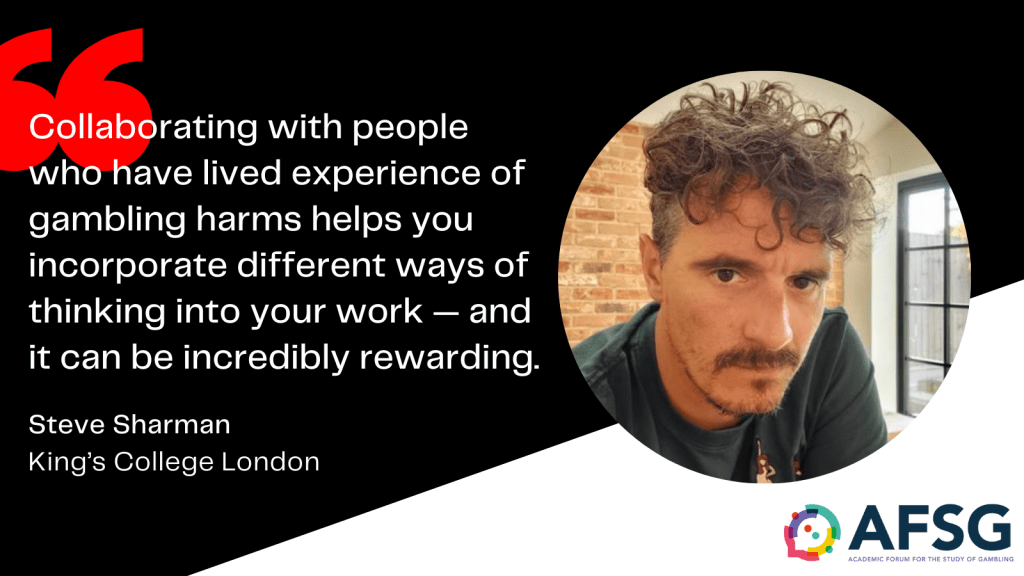
Steve Sharman is a Senior Research Fellow at King’s College London with interests in gambling, behavioural addictions and decision making. He is also a member of the Executive Committee of the AFSG and co-organises the Current Advances in Gambling Research (CAGR) conference each year. In this month’s conversation, Steve talks about the importance of lived experience, the need for an independent and inclusive conference for researchers to share their work, the use of virtual reality in gambling research, and much more.
A few weeks ago, Steve and his team launched the Lived Experience Research Hub (LERH), a new website designed to improve collaboration between academics and people with lived experience of gambling harms. ‘Often, researchers would have what they thought was a great idea for a piece of work and would then try to bring in people with lived experience once the project had already started,’ says Steve. The problem with this approach is that the inclusion of lived experience comes too late. ‘We advocate for lived experience to be incorporated into the research process from the very start, so we need to provide an avenue for academics and people with lived experience to find one another,’ says Steve. The LERH’s matching service does this by allowing academics to post details of jobs for which they are looking for people with lived experience. The idea, explains Steve, is to promote deeper and more impactful ways of incorporating lived experience into every stage of the research process.
Reflecting on his own work, Steve admits that incorporating lived experience into the research process isn’t without its challenges. ‘Sometimes people with lived experience will ask me why I’m approaching a particular issue in a given way,’ he says. ‘Responding with “because that’s the way we do things in academia” just doesn’t cut it,’ he concedes. ‘Collaborating with people who have lived experience of gambling harms helps you incorporate different ways of thinking into your work — and it can be incredibly rewarding.’
Another element of the LERH is the Minimum Standards Framework (MSF). Steve and many of his colleagues have witnessed examples of lived experience involvement that don’t go to plan. Developed in collaboration with individuals with lived experience of gambling harm, the MSF is intended to address some of the more common issues identified both by academics and people with lived experience when it comes to establishing productive collaborative working relationships. ‘The MSF is not designed to be a set of instructions, more a set of guidelines to provide academics with a framework of how best to work with people with lived experience,’ says Steve. It provides practical advice on issues like the provision of support and care, fair remuneration, and safeguarding.
The inclusion of lived experience in the research process extends to the annual Current Advances in Gambling Research (CAGR) conference, which Steve and fellow academics Amanda Roberts and Simon Dymond established a few years ago. CAGR was founded to provide gambling studies academics with a way to present their work to one another to gain critical, but friendly feedback from colleagues. As part of this, the conference has tried hard in recent years to incorporate lived experience, including by prioritising speakers whose work includes a strong element of lived experience. ‘From the outset, we wanted the conference to provide an independent and inclusive environment in which gambling studies research could be presented,’ says Steve. As part of this commitment, Steve and colleagues have sought to foster the equal involvement of early career researchers alongside more established academics, as well as committing to eliminating all-male panels and providing bursaries for participants from the Global South. ‘We also offer heavily discounted tickets for students, people with lived experience and the unwaged,’ says Steve. According to Steve, the preliminary programme for CAGR 2025 (which takes place in Glasgow in June and has a few tickets remaining) showcases this commitment to inclusivity, with a strong focus this year on global perspectives and the inclusion of lived experience. ‘There’s still more to be done,’ he says, but he hopes that through commitments like these CAGR can be a forum for more equitable and accessible gambling studies research.
Beyond running a website, organising a conference, acting as a trustee for the Society for the Study of Addiction (SSA) and sitting on the Advisory Board for Safer Gambling (ABSG) and the AFSG’s Executive Committee, however, Steve’s primary role remains gambling research. At present, he’s working on a UKRI-funded piece of research that uses virtual reality (VR) to better understand the psychological underpinnings of gambling behaviour. The use of VR arose from criticism of more traditional studies of gambling behaviour where participants, for example, would be asked to hit the spacebar or click a mouse on a very crude gambling game on a PC. While offering a high degree of experimental control, the trade-off with such methodologies is that they are not always reflective of real-world gambling conditions or environments, meaning research findings are necessarily constrained. By using VR, Steve hopes to improve the ecological validity of such studies by immersing participants in a much more realistic environment in which multiple variables can be controlled.
The use of VR and the creation of a much more immersive environment, however, aren’t without their challenges. Electronic gaming machines incorporate several mechanisms aimed at encouraging players to spend more time and money on them. Replicating these conditions too closely or not ensuring sufficient safety mechanisms could expose study participants to unacceptable levels of potential harms. For these reasons, Steve’s work with VR incorporates several safety mechanisms, such as removing potential participants with Problem Gambling Severity Index (PGSI) scores above a certain level, keeping VR sessions relatively short, and debriefing all participants at the end of their session.
Another area of research for Steve in recent years has been football and its relationship with gambling. As well as being a research interest of his, however, football is also a personal interest. One question that arises is whether gambling as a research topic has affected his enjoyment of football as a passion. ‘I wouldn’t say it’s affected my enjoyment of the game, but it has 100% affected how I view the game,’ admits Steve. ‘It’s impossible to watch a Premier League football match, or my team, Derby County, now without thinking about work,’ he says. It does, perhaps, go some way to explaining why Steve prefers to follow non-league football. ‘Non-league football is much more community focussed, and isn’t saturated with gambling ads and companies,’ says Steve. Shirt sponsors are more likely to be local companies than big betting firms and there’s very little gambling content on the clubs’ social media feeds. ‘I still enjoy the sport,’ says Steve, ‘but maybe my work has influenced the type of football I follow’.
 Academic Forum for the Study of Gambling