
The Research Committee of the AFSG has recently confirmed the recipients for 2025’s major and minor exploratory grants. The funded projects will examine how to improve retention in NHS gambling services, the relationships between social identification with sports and gambling behaviours, and the use of natural language processing to understand how first-hand gambling experience relates to Problem Gambling Severity Index (PGSI) scores.

High dropout rates from addiction treatment services have been documented globally. There can be many drivers behind dropout, although current understanding of the precise reasons and predictors of dropout among people in the UK seeking help for problem gambling is relatively weak. Matt Field (University of Sheffield) will lead a major exploratory research project that looks at the factors underlying dropout, including among people who are referred (or self-refer) to a service but do not attend an initial appointment. Using data from the NHS Northern Gambling Service, Matt and his team will use machine learning methods to study predictors of treatment retention/dropout and to better understand why 40% of those referred to the service do not attend an initial appointment. Discussing the study and its potential impacts, Matt says:
“My colleagues and I are excited to begin this programme of work, which will use advanced statistical techniques that have been used in other areas of mental health and clinical psychology in recent years. We are delighted to partner with the NHS Northern Gambling Clinics, and our findings will shed light on the factors that determine dropout from treatment, in many cases even before the initial clinical assessment. Our approach has the potential to identify client characteristics and other contextual factors that can be the target of focussed interventions to improve engagement and retention in treatment, and thereby improve the outcomes of treatment”.
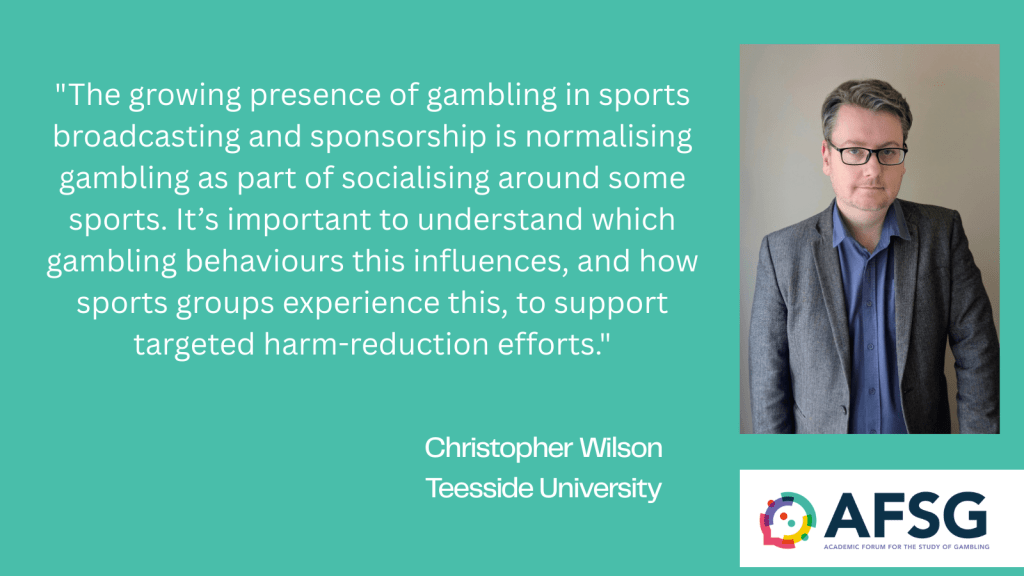
Meanwhile, the first of two minor exploratory awards has gone to Dr. Christopher Wilson (Teesside University) for a project exploring how social identification with sports groups predicts gambling behaviour. In addition, the research will examine the normalisation of gambling within certain sports groups and develop recommendations for stakeholders on their approaches to gambling harm reduction. Highlighting the links between sport and gambling in the UK, Christopher comments:
“The increasing prominence of gambling in professional sports broadcasting and sponsorship creates an association between them, to the extent that gambling is starting to become a normalised part of socialising around some sports. It’s important that we understand which features of gambling behaviour are predicted by this relationship, and how sports groups experience the exposure to gambling, so we can provide evidence to support targeted harm-reduction approaches.”
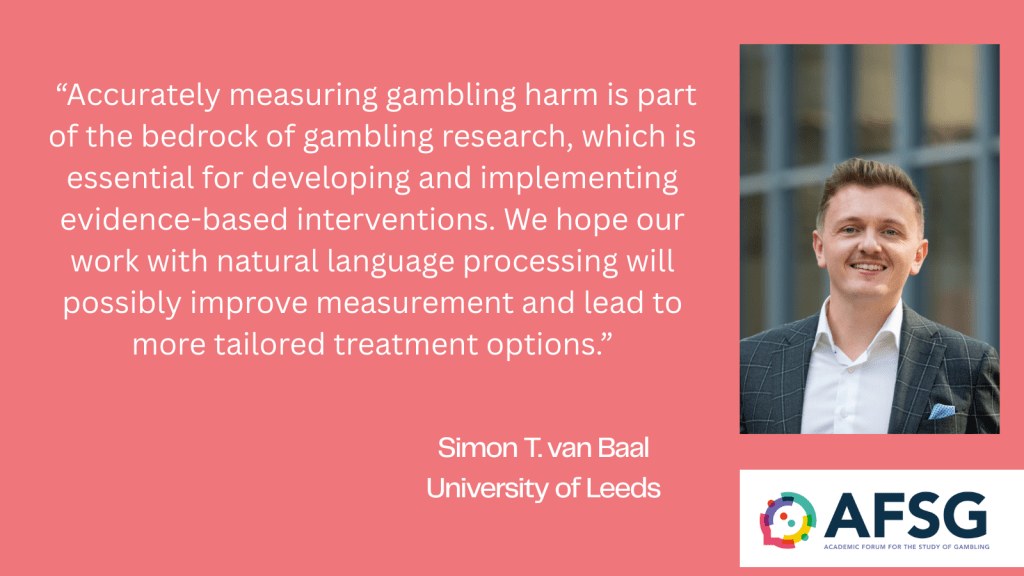
The second minor exploratory grant has been awarded to Simon T. van Baal (University of Leeds) for his research using natural language processing (NLP) to examine how narrative descriptions of gambling experiences correlate with PGSI scores. The PGSI questionnaire is one of the most commonly used tools to assess gambling harm, although it relies on people being able to accurately recall their activities and willing to admit when gambling has caused them harm. In addition, some yes/no questions do not allow for fuller explanations of those answers. This project will use natural language processing and artificial intelligence to analyse autobiographical descriptions of gambling behaviour and gambling harms. The research aims to use these technologies to identify how autobiographical accounts of gambling activity and gambling harms relate to PGSI scores and whether NLP models can be used as predictors of gambling harm. Talking about the use of NLP and artificial intelligence to identify gambling harms, Simon says:
My collaborators, Philip Newall and Lukasz Walasek, and I are excited to embark on this new project and thank the AFSG for their support. We believe accurately measuring gambling harm is part of the bedrock of gambling research, which is essential for developing and implementing evidence-based interventions. Understanding how the state-of-the-art measurement tools map onto real-life experiences will help us see the person behind the questionnaire score, possibly improving measurement and more tailored treatment options.
Work on all three research projects is expected to begin in mid-2025 and it is hoped that insights from each will help to improve the identification and treatment of gambling harms in the UK.
 Academic Forum for the Study of Gambling