
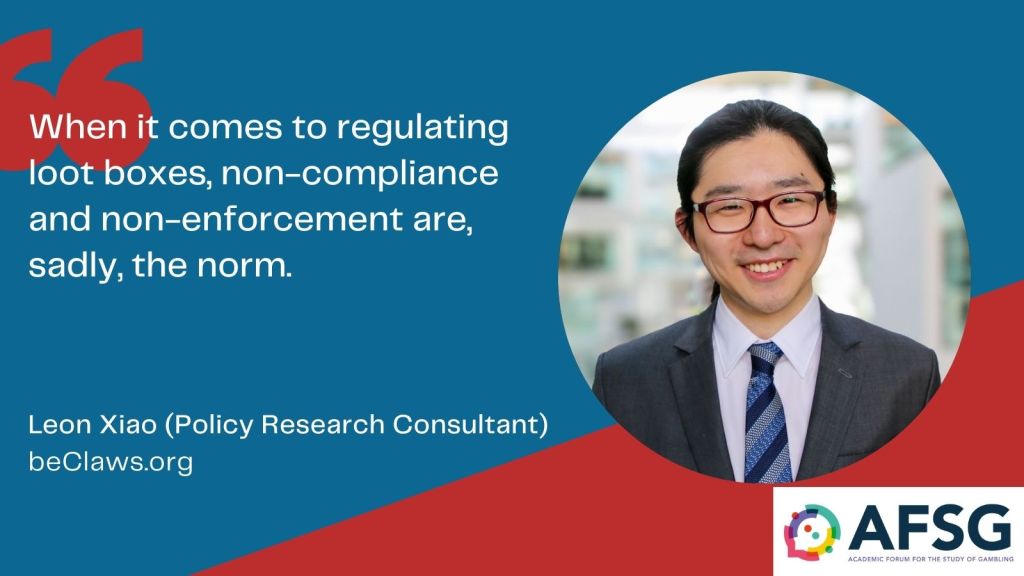
AFSG members come from many different disciplines – psychology, public health, psychiatry, economics, and urban geography to name but a few. As a barrister and having recently submitted a PhD on the regulation of gambling-like products in video games, Leon Xiao is no exception. But while he does have a legal education and background, however, Leon sees himself as more of an interdisciplinary researcher whose methods are well suited to the field of gambling studies. In this month’s member spotlight interview, we discuss Leon’s journey into video game regulation, the pros and cons of ‘light touch’ enforcement, influencing policymakers and more.
Leon’s first real opportunity to work on technology law came as an undergraduate during a year abroad programme in Singapore. At the time, says Leon, UK law schools didn’t tend to offer modules on tech law, but Singapore did. ‘It was 2018 and the debate around loot boxes [random in-game purchases] was making the news, so studying them and other gambling-like products in video games seemed apt’, says Leon. This initial interest in video games and their regulation would subsequently form the basis for his recently submitted PhD thesis.
Unfortunately, Leon’s research paints a dispiriting picture of loot box regulation and enforcement both in the UK and around the world. He admits that there is no one model of regulation that seems to work especially well when it comes to gambling-like products in video games. While there are some aspects of regulation, such as probability disclosures for loot boxes, that have broad acceptance, Leon argues that other attempts at regulation work much less well. Beyond the biggest games and largest markets, compliance drops markedly. ‘Broadly, the pattern is non-compliance and non-enforcement’, says Leon.
Compliance and enforcement don’t necessarily have to originate from an uncompromising, tough legal framework. Leon has plenty of experience of submitting complaints to the UK’s self-regulator Advertising Standards Agency (ASA) regarding non-compliance of video games companies. His initial efforts bore fruit, as the ASA would investigate and publish their findings. Sometimes, the bad PR would be sufficient to get companies to improve their compliance. More recently, however, the ASA has been less inclined to publish details of repeated infractions by games companies. The result is that there is no public record showing non-compliance by companies, meaning there is little chance of the issue being pursued by official regulators such as Trading Standards or the Competition and Markets Authority (CMA).
Even where informal approaches do bear fruit, the improved compliance may not be sustained over time. When news emerged last year of a celebrity endorsing a popular game that did not comply with advertising regulations around loot boxes, the company took action to include prominent disclosure information in their ads. A couple of months later, however, that disclosure information had slipped to the end of their ads and may have once again been in breach of UK and EU regulations.
All the indications point to a system of compliance, regulation and enforcement that is generally ineffective in multiple countries. Despite this, there is a glimmer of hope when it comes to countries learning from one another. According to Leon, there are positive instances where lessons from one country can be picked up and learned by policymakers and legislators in another. He has personally written to several countries regarding loot box regulation and has received some positive replies. Unfortunately, misunderstandings are common too. A report from New Zealand, for instance, erroneously claimed that the UK had banned loot boxes for under 18s. These misunderstandings of policy and regulation risk creating a system whereby actions are based on incorrect or poorly understood evidence.
As our call draws to a close, the conversation turns to Leon’s experiences as a PhD student. In particular, he is keen to encourage other postgrads and PhD students to apply for funding opportunities, including AFSG’s postgraduate research and conference/travel funding. He says that it can be difficult for postgraduate students to show a track record of successfully applying for funding because of the relative paucity of opportunities available. Funding like AFSG’s, however, not only enables students to build that track record, but also provides them with access to a whole network of academics and researchers in their field.
I finish up by asking Leon what’s next. Having recently submitted his PhD thesis, he is hoping to move into a career in academia. His research points to a regulatory framework everywhere that is ill equipped to deal with the challenges of loot boxes and gambling-like products in video games. There is a need for any action to be based on rigorous, up-to-date evidence and Leon hopes to be part of the conversation.
 Academic Forum for the Study of Gambling